MAPIE ships with several predefined risks and performance metrics for binary
classification (precision, recall, accuracy, false positive rate...). When the
metric you care about is not one of them, you can define your own with
BinaryRisk and control it exactly like a predefined one.
In this example, we show how to define
specificity (the true negative rate) as a custom risk and use it with the
BinaryClassificationController.
Specificity is the proportion of actual negatives that are correctly predicted
as negative. It is a natural target in screening problems where we want to avoid
raising too many alarms on healthy/benign cases, while keeping recall (the
ability to catch the positive cases) as high as possible.
In a Jupyter environment, please rerun this cell to show the HTML representation or trust the notebook. On GitHub, the HTML representation is unable to render, please try loading this page with nbviewer.org.
Any metric that can be written as
sum(occurrence if condition) / sum(condition) can be controlled by the
BinaryClassificationController, thanks to the Learn Then Test framework
implemented in MAPIE.
A BinaryRisk is therefore defined by two per-sample functions, both taking
the ground-truth labels y_true and the predictions y_pred and
returning boolean arrays:
risk_condition: which samples count towards the metric (the denominator),
risk_occurrence: among those, which ones are a "success" (the numerator).
For specificity (true negative rate), we look at the actual negatives
(y_true == 0, the condition) and count those that are correctly predicted
as negative (y_pred == 0, the occurrence). In other words,
specificity = count(y_pred == 0 and y_true == 0) / count(y_true == 0).
Because a higher specificity is better, we set higher_is_better=True so
that MAPIE treats it as a performance metric rather than a risk.
We now initialize a BinaryClassificationController using the probability
estimation function of the fitted estimator (clf.predict_proba), our
custom specificity risk, a target level, and a confidence level. The
controller thresholds the predicted probability of the positive class: a
higher threshold predicts fewer positives, which mechanically increases
specificity but lowers recall.
When a custom risk is used, best_predict_param_choice="auto" cannot guess
a sensible secondary objective, so we specify one explicitly. Here we maximize
recall: among all thresholds that guarantee the target specificity, the
controller selects the one that catches the most positive cases.
target_specificity=0.8confidence_level=0.9bcc=BinaryClassificationController(clf.predict_proba,specificity,target_level=target_specificity,confidence_level=confidence_level,best_predict_param_choice="recall",)bcc.calibrate(X_calib,y_calib)print(f"{len(bcc.valid_predict_params)} thresholds found that guarantee a specificity "f"of at least {target_specificity} with a confidence of {confidence_level}.\n""Among those, the one that maximizes the secondary objective (recall here) is: "f"{bcc.best_predict_param:.2f}.")
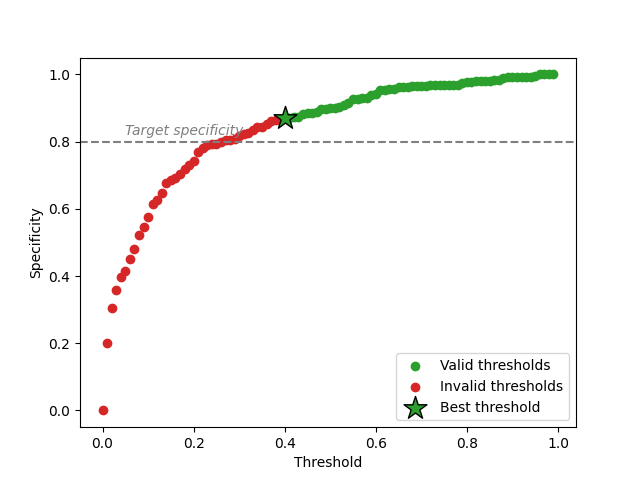
Just like with a predefined risk, we can visualize how the threshold values
impact specificity and which thresholds are statistically guaranteed.
proba_positive_class=clf.predict_proba(X_calib)[:,1]tested_thresholds=bcc._predict_paramsspecificities=np.full(len(tested_thresholds),np.inf)fori,thresholdinenumerate(tested_thresholds):y_pred=(proba_positive_class>=threshold).astype(int)# specificity is the recall of the negative classspecificities[i]=recall_score(y_calib,y_pred,pos_label=0)valid_thresholds_indices=np.array([tinbcc.valid_predict_paramsfortintested_thresholds])best_threshold_index=np.where(tested_thresholds==bcc.best_predict_param)[0][0]plt.figure()plt.scatter(tested_thresholds[valid_thresholds_indices],specificities[valid_thresholds_indices],c="tab:green",label="Valid thresholds",)plt.scatter(tested_thresholds[~valid_thresholds_indices],specificities[~valid_thresholds_indices],c="tab:red",label="Invalid thresholds",)plt.scatter(tested_thresholds[best_threshold_index],specificities[best_threshold_index],c="tab:green",label="Best threshold",marker="*",edgecolors="k",s=300,)plt.axhline(target_specificity,color="tab:gray",linestyle="--")plt.text(0.05,target_specificity+0.02,"Target specificity",color="tab:gray",fontstyle="italic",)plt.xlabel("Threshold")plt.ylabel("Specificity")plt.legend()plt.show()
Like in the quickstart, low thresholds correspond to specificity values below
the target and are therefore invalid. Some thresholds whose empirical
specificity is above the target are also rejected: risk control takes a margin
to account for the uncertainty due to the finite size of the calibration set,
so that the guarantee holds on unseen data with high probability.
We can confirm this on the test set by using the predict method of the
controller, which applies the best threshold.
y_pred_test=bcc.predict(X_test)test_specificity=recall_score(y_test,y_pred_test,pos_label=0)test_recall=recall_score(y_test,y_pred_test,pos_label=1)print("With the best threshold, on the test set:\n"f"- specificity is {test_specificity:.3f} (target was {target_specificity}),\n"f"- recall is {test_recall:.3f}.")
The specificity measured on the test set is close to (and above) the target,
illustrating that the guarantee obtained on the calibration set transfers to
unseen data. The same recipe applies to any binary metric that can be written
as sum(occurrence if condition) / sum(condition): define it once with
BinaryRisk, then control it with the BinaryClassificationController.
Total running time of the script: ( 0 minutes 1.203 seconds)