SplitConformalRegressor and
ConformalizedQuantileRegressor
are used to conformalize uncertainties for large models for
which the cost of cross-validation is too high. Typically,
neural networks rely on a single validation set.
In this example, we first fit a neural network on the training set. We
then compute residuals on a validation set with the prefit=True parameter.
Finally, we evaluate the model with prediction intervals on a testing set.
In a second part, we will also show how to use the prefit method in the
conformalized quantile regressor.
We start by defining a function that we will use to generate data. We then
add random noise to the y values. Then we split the dataset to have
a training, conformalize and test set.
deff(x:NDArray)->NDArray:"""Polynomial function used to generate one-dimensional data."""returnnp.array(5*x+5*x**4-9*x**2)# Generate datarng=np.random.default_rng(59)sigma=0.1n_samples=10000X=np.linspace(0,1,n_samples)y=f(X)+rng.normal(0,sigma,n_samples)# Train/conformalize/test split(X_train,X_conformalize,X_test,y_train,y_conformalize,y_test)=(train_conformalize_test_split(X,y,train_size=0.8,conformalize_size=0.1,test_size=0.1,random_state=RANDOM_STATE,))
For this example, we will train a
MLPRegressor for
SplitConformalRegressor.
# Train a MLPRegressor for SplitConformalRegressorest_mlp=MLPRegressor(activation="relu",random_state=RANDOM_STATE)est_mlp.fit(X_train.reshape(-1,1),y_train)
MLPRegressor(random_state=1)
In a Jupyter environment, please rerun this cell to show the HTML representation or trust the notebook. On GitHub, the HTML representation is unable to render, please try loading this page with nbviewer.org.
We will now proceed to conformalize the models using MAPIE. To this aim, we set
prefit=True so that we use the model that we already trained prior.
We then predict using the test set and evaluate its coverage.
# Conformalize uncertainties on conformalize setmapie=SplitConformalRegressor(estimator=est_mlp,confidence_level=confidence_level,prefit=True)mapie.conformalize(X_conformalize.reshape(-1,1),y_conformalize)# Evaluate prediction and coverage level on testing sety_pred,y_pis=mapie.predict_interval(X_test.reshape(-1,1))coverage=regression_coverage_score(y_test,y_pis)[0]
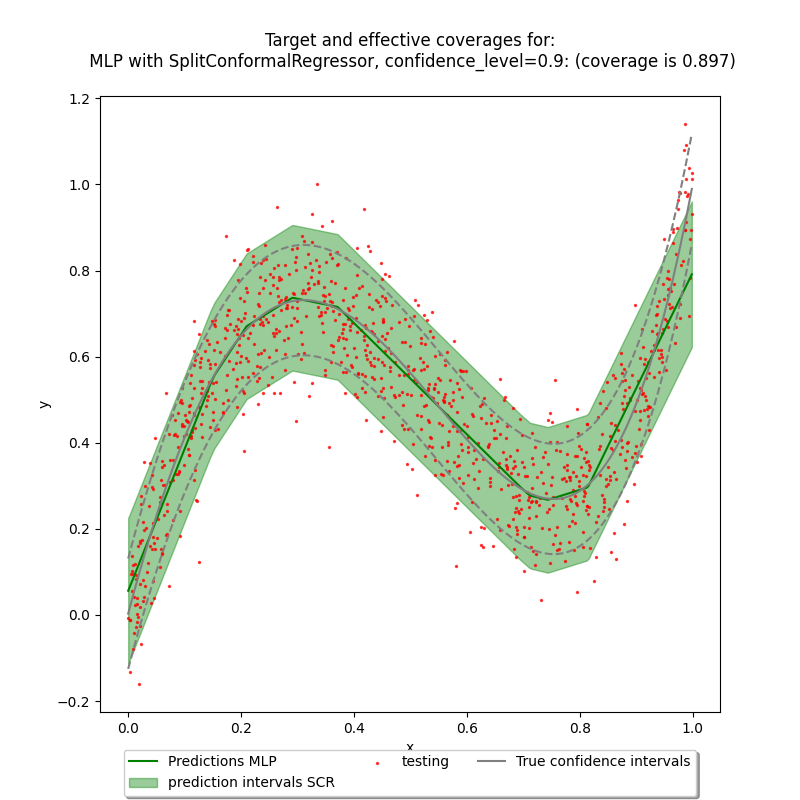
In order to view the results, we will plot the predictions of the
the multi-layer perceptron (MLP) with their prediction intervals calculated with
SplitConformalRegressor.
# Plot obtained prediction intervals on testing settheoretical_semi_width=scipy.stats.norm.ppf(1-confidence_level)*sigmay_test_theoretical=f(X_test)order=np.argsort(X_test)plt.figure(figsize=(8,8))plt.plot(X_test[order],y_pred[order],label="Predictions MLP",color="green")plt.fill_between(X_test[order],y_pis[:,0,0][order],y_pis[:,1,0][order],alpha=0.4,label="prediction intervals SCR",color="green",)plt.title(f"Target and effective coverages for:\n "f"MLP with SplitConformalRegressor, confidence_level={confidence_level}: "+f"(coverage is {coverage:.3f})\n")plt.scatter(X_test,y_test,color="red",alpha=0.7,label="testing",s=2)plt.plot(X_test[order],y_test_theoretical[order],color="gray",label="True confidence intervals",)plt.plot(X_test[order],y_test_theoretical[order]-theoretical_semi_width,color="gray",ls="--",)plt.plot(X_test[order],y_test_theoretical[order]+theoretical_semi_width,color="gray",ls="--",)plt.xlabel("x")plt.ylabel("y")plt.legend(loc="upper center",bbox_to_anchor=(0.5,-0.05),fancybox=True,shadow=True,ncol=3)plt.show()
For this example, we will train multiple LGBMRegressor with a
quantile objective as this is a requirement to perform conformalized
quantile regression using
ConformalizedQuantileRegressor. Note that the
three estimators need to be trained at quantile values of
(1+confidence_level)/2, (1-confidence_level)/2, 0.5).
# Train LGBMRegressor models for _MapieQuantileRegressorlist_estimators_cqr=[]foralpha_in[(1-confidence_level)/2,(1+confidence_level)/2,0.5]:estimator_=LGBMRegressor(objective="quantile",alpha=alpha_,)estimator_.fit(X_train.reshape(-1,1),y_train)list_estimators_cqr.append(estimator_)
We will now proceed to conformalize the models using MAPIE. To this aim, we set
prefit=True so that we use the models that we already trained prior.
We then predict using the test set and evaluate its coverage.
# Conformalize uncertainties on conformalize setmapie_cqr=ConformalizedQuantileRegressor(list_estimators_cqr,confidence_level=0.9,prefit=True)mapie_cqr.conformalize(X_conformalize.reshape(-1,1),y_conformalize)# Evaluate prediction and coverage level on testing sety_pred_cqr,y_pis_cqr=mapie_cqr.predict_interval(X_test.reshape(-1,1))coverage_cqr=regression_coverage_score(y_test,y_pis_cqr)[0]
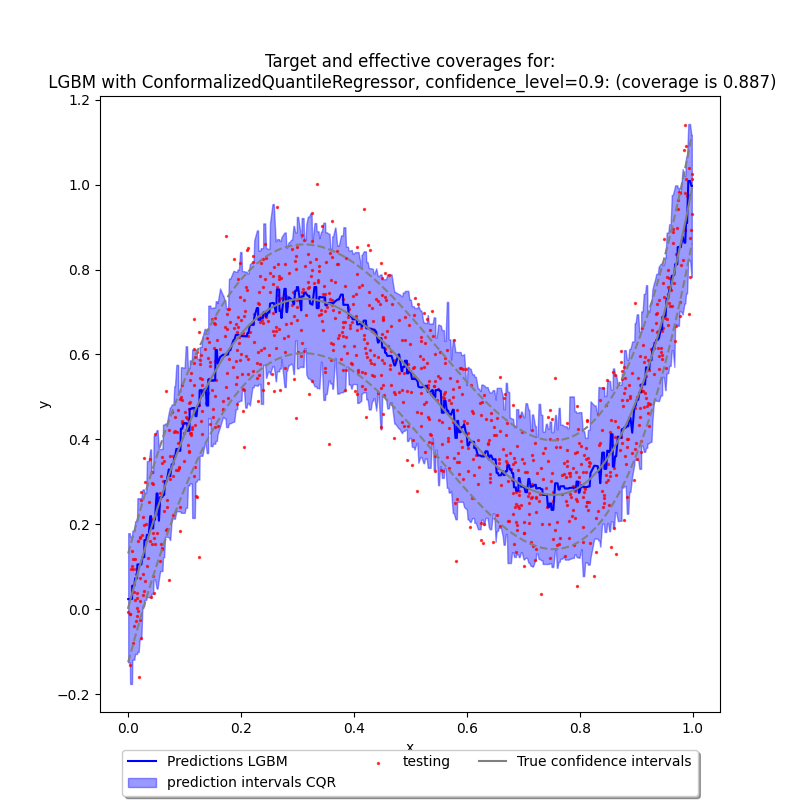
As fdor the MLP predictions, we plot the predictions of the LGBMRegressor
with their prediction intervals calculated with
ConformalizedQuantileRegressor.
# Plot obtained prediction intervals on testing settheoretical_semi_width=scipy.stats.norm.ppf(1-confidence_level)*sigmay_test_theoretical=f(X_test)order=np.argsort(X_test)plt.figure(figsize=(8,8))plt.plot(X_test[order],y_pred_cqr[order],label="Predictions LGBM",color="blue")plt.fill_between(X_test[order],y_pis_cqr[:,0,0][order],y_pis_cqr[:,1,0][order],alpha=0.4,label="prediction intervals CQR",color="blue",)plt.title(f"Target and effective coverages for:\n "f"LGBM with ConformalizedQuantileRegressor, confidence_level={confidence_level}: "+f"(coverage is {coverage_cqr:.3f})")plt.scatter(X_test,y_test,color="red",alpha=0.7,label="testing",s=2)plt.plot(X_test[order],y_test_theoretical[order],color="gray",label="True confidence intervals",)plt.plot(X_test[order],y_test_theoretical[order]-theoretical_semi_width,color="gray",ls="--",)plt.plot(X_test[order],y_test_theoretical[order]+theoretical_semi_width,color="gray",ls="--",)plt.xlabel("x")plt.ylabel("y")plt.legend(loc="upper center",bbox_to_anchor=(0.5,-0.05),fancybox=True,shadow=True,ncol=3)plt.show()
Total running time of the script: ( 0 minutes 1.005 seconds)