Note
Go to the end to download the full example code.
Plotting Bagging Regression Error Bars
This example demonstrates using forestci to calculate the error bars of
the predictions of a sklearn.ensemble.BaggingRegressor object.
The data used here are the Auto MPG dataset by R. Quinlan, bundled under the
Creative Commons Attribution 4.0 International license. See data/README.md
for attribution and licensing details.
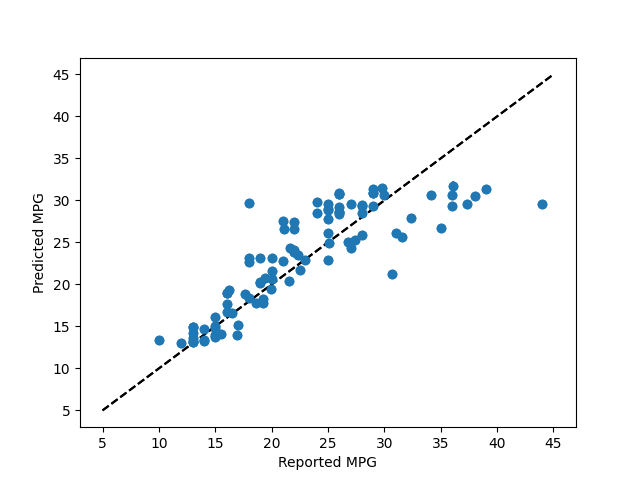
# Regression Forest Example
from pathlib import Path

import numpy as np
from matplotlib import pyplot as plt
from sklearn.ensemble import BaggingRegressor
from sklearn.svm import SVR
import sklearn.model_selection as xval
import forestci as fci

# Seed the calibration subsampling as well as the fitted models.
np.random.seed(42)

# Load the bundled Auto MPG data
data_path = Path.cwd() / "data" / "auto_mpg.csv"
if not data_path.exists():
    # Also support running ``python examples/plot_mpg_svr.py`` from the repo root.
    data_path = Path.cwd() / "examples" / "data" / "auto_mpg.csv"
mpg_data = np.genfromtxt(
    data_path,
    delimiter=",",
    skip_header=1,
)

# Separate the predictors and target, removing rows with missing values
mpg_data = mpg_data[~np.isnan(mpg_data).any(axis=1)]
mpg_X = mpg_data[:, :-1]
mpg_y = mpg_data[:, -1]

# Split the data into training and test sets
X_train, X_test, y_train, y_test = xval.train_test_split(
    mpg_X, mpg_y, test_size=0.25, random_state=42
)

# Create a bagged SVR model
n_estimators = 1000
bagger = BaggingRegressor(
    estimator=SVR(), n_estimators=n_estimators, random_state=42
)
bagger.fit(X_train, y_train)
y_pred = bagger.predict(X_test)
target_range = [mpg_y.min(), mpg_y.max()]

# Plot predictions without error bars
plt.scatter(y_test, y_pred)
plt.plot(target_range, target_range, "k--")
plt.xlabel("Reported MPG")
plt.ylabel("Predicted MPG")
plt.show()

# Calculate the variance
variance = fci.random_forest_error(bagger, X_train.shape, X_test)

# Plot error bars for predictions using unbiased variance
plt.errorbar(y_test, y_pred, yerr=np.sqrt(variance), fmt="o")
plt.plot(target_range, target_range, "k--")
plt.xlabel("Reported MPG")
plt.ylabel("Predicted MPG")
plt.show()
Total running time of the script: (0 minutes 4.200 seconds)